There is nothing more thrilling than seeing a spacecraft launch — especially on a journey to the moon.
More than half a century after the last lunar mission during NASA’s Apollo program, humans are finally aiming to travel back to the vicinity of the moon on a mission called Artemis II. During the 10-day journey, four astronauts will venture farther into deep space than any human has before.
It’s a historic event that you won’t want to miss. But following every moment might be a little confusing if you’re not familiar with the terminology surrounding this mission. Launch directors often use jargon and shorthand that can sound like an unfamiliar language.
Here are some of the terms you might hear, as well as key milestones to listen for.
T Minus, ingress and other liftoff lingo

NASA is aiming to launch Artemis II in April. If the launch is a go, that means things are on track to take off. If it’s a no go, the launch may be postponed.
As mission teams progress through the countdown, expect to hear SLS, which stands for Space Launch System, to indicate the rocket. If the word nominal is used, it means that things are normal or going as planned.
When the rocket is being loaded with cryogenic or supercold fuel for liftoff, the terms LOX and LH2 will reference liquid oxygen and liquid hydrogen, respectively. The rocket will go through multiple phases of fueling, referred to as slow fill, fast fill, topping and replenishing.
During the countdown, you will hear L Minus and T Minus times.
L Minus is used to indicate the time until liftoff in hours and minutes, while T Minus corresponds with the events included in the launch countdown, like the retracting of the crew access arm, which enables astronauts to board the spacecraft, or the starting of the engines in the final seconds before liftoff.

If the launch team announces a hold, this indicates a natural pause in the countdown, which is intended to allow for tasks to be performed or for a slight delay so that liftoff will align with a specific launch time that doesn’t disrupt the schedule. During a hold, expect the countdown clock and T Minus time to stop, while the L Minus time will continue.
A few hours prior to launch, the astronauts will head to the White Room, an environmentally controlled staging area where the crewmembers will don their helmets and gloves, before ingress, or boarding of Orion crew module — their home for the next 10 days.
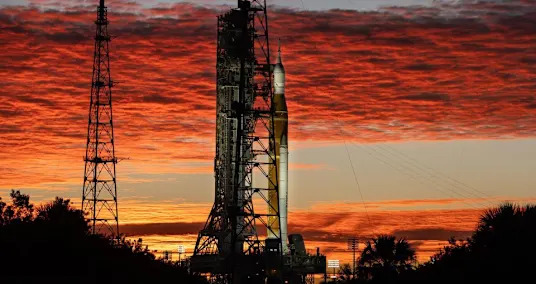
The Orion capsule and the SLS rocket sit on the mobile launcher, an all-in-one ground platform that can transfer the rocket and capsule out to the pad. This platform is used for testing and servicing of the rocket — and ultimately, launch.
The ground launch sequencer, or a computer that tells the rocket when to launch, will initiate terminal count. This is the final, and largely automated, phase of countdown that spans the last 10 minutes before liftoff.
After the engines start up and the booster ignites, umbilical separation, or the disconnecting of power cables and fuel lines, will take place — the last step before the rocket launches.
All the ‘burns’ it takes to reach the moon

There is a good chance the Artemis launch team will make frequent mention of ICPS, which refers to the interim cryogenic propulsion stage. This upper segment of the rocket will give the Orion capsule the propulsion it needs to continue on in space after the two solid-fuel rocket boosters and core stage of the rocket separate from the spacecraft.
The core stage is the backbone of the rocket and includes engines, propellant tanks and avionics, or aviation electronic systems.
After the launch, you may hear the solid rocket boosters referred to as SRB and the launch abort system as LAS. Two of the launch abort system’s three engines can be used to return the Orion capsule safely to Earth in the event of a malfunction or systems failure during launch. The third engine is used to jettison the launch abort system, which occurs shortly after launch if all goes well.

About eight minutes after launch, core stage MECO, or main engine cut-off, will occur, signaling the shutdown and separation of the SLS’s core stage from the ICPS and Orion. Stay tuned for a fun moment when the zero gravity indicator — a plush toy chosen by the Artemis II crew — floats into view, showing that the astronauts are now in the space environment.
Several burns, when the propulsion system fires up to help the spacecraft stay on course or reach a new orbit, will be mentioned post-liftoff.
The perigee raise maneuver will occur about 49 minutes after launch. That’s when the ICPS experiences a burn to raise Orion’s altitude and place it in a stable low-Earth orbit.

The ICPS will fire again about an hour later for the apogee raise burn, which boosts Orion into a higher orbit. After this burn, it will separate from Orion.
Before the ICPS eventually burns up over the Pacific Ocean, the Artemis II crew will practice docking Orion to it in a Proximity Operations Demonstration. This will allow NASA to practice piloting the capsule toward and around the ICPS, as astronauts will need to do during future missions.
A perigree raise burn, or an additional firing of the engine, on the first day of flight will put Orion in the optimal position before the translunar injection burn, another big step of the journey on the second flight day.
Entering the lunar sphere of influence
The translunar injection burn increases Orion’s velocity, allowing it to leave behind a circular orbit of Earth and transfer to an oval-shaped orbit that will help it reach the moon. This will be the last major engine firing of the mission. During the burn, Orion’s service module, which provides the spacecraft with power, propulsion and thermal control, will give the capsule a big push to embark on a four-day trip around the moon before completing a figure eight to return to Earth.
Smaller orbital trajectory correction burns will occur over the following days, ensuring that Orion stays on target for its lunar flyby. On flight day five, Orion will enter the lunar sphere of influence, or the point in space where the tug of the moon’s gravity is stronger than Earth’s gravity.
After swinging around the far side of the moon and exiting the lunar sphere of influence, three small burns will ensure Orion is on the right course for splashdown, with the last one occurring on the 10th day of the flight.
Orion’s service module, which includes the engines responsible for the burns that have kept the capsule moving along the right trajectory, will separate from Orion to expose the heat shield, intended to protect the astronauts during reentry, or the reentering of Earth’s atmosphere.

After the blistering heat of reentry subsides, drogue parachutes will release to begin slowing down Orion’s descent, followed by pilot parachutes that are responsible for unfurling the capsule’s three main parachutes that further reduce Orion’s speed from 130 to 17 miles per hour (about 200 to 30 kilometers per hour). Once it has sufficiently slowed, the capsule will splash down off the coast of California.
The Artemis program is expected to continue with additional lunar missions throughout the rest of this decade — including an eventual landing on the moon’s surface. Now you know exactly how to sound like a crewmember who’s been to the moon and back while you watch the excitement unfold.
NASA’s Artemis program is sending humans into deep space for the first time in more than five decades. Sign up for Countdown newsletter and get updates from CNN Science on out-of-this-world expeditions as they unfold.
For more CNN news and newsletters create an account at CNN.com
latest_posts
- 1
 EU foreign ministers commemorate Russian massacre in Bucha
 - 2Go on A Careful spending plan: Modest Objections for Your List of must-dos
- 3FDA proposes use of sunscreen ingredient popular in other countries
- 4New movies to watch this weekend: See 'We Bury the Dead' in theaters, rent 'Wicked: For Good,' stream 'The Unbreakable Boy' on Starz
- 5Key Training: Picking a Significant for Monetary Achievement



- Israeli lawmakers pass bill reviving death penalty for terrorists
- SpaceX launches Starlink satellites on its 150th Falcon 9 mission of the year
- I served on the expert committee that advised the government on new dietary guidelines – most of our recommendations were ignored
- Health officials report 14 Legionnaires' disease cases in Florida, gym connection suspected
- Dental Embed Innovation: An Achievement in Helpful Dentistry
- Bolsonaro says hallucinatory effects of meds made him tamper with ankle tag
- Individual Preparation Administrations to Raise Your Wellness Process
- 'No middle ground' for tackling antisemitism after Bondi Beach mass shooting, deputy FM Haskel says
- Scientists captured female sperm whales on video working together during a birth to protect the calf